
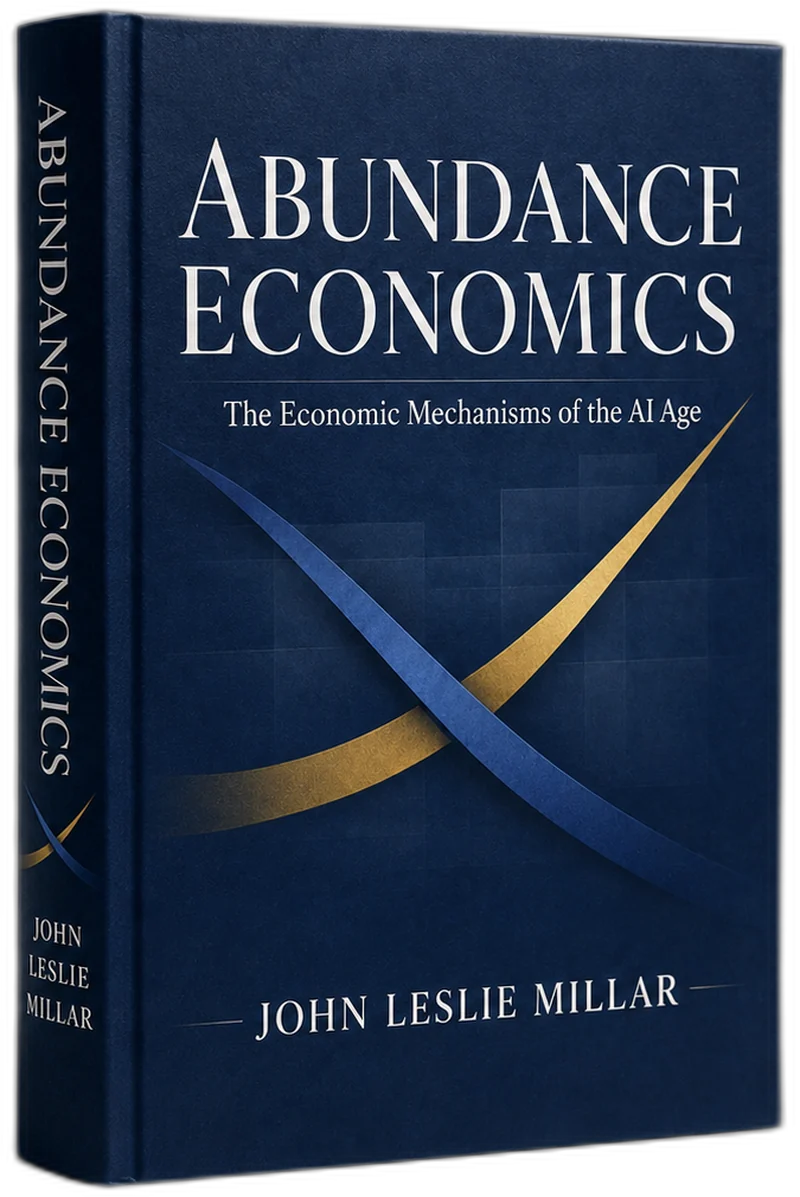
Abundance Economics: The Economic Mechanisms of the AI Age

Every previous technology made workers more productive.AI makes the workers.
AI as an input to the economy
Abundance Economics treats AI not as a marvel or a menace, but as a growing share of work moving from people to software and machines—and follows that shift through to its consequences: structural price disruption, transformed competition, disappearing tax bases and career ladders with disappearing rungs.
The model follows a three-stage chain: work shifts from biological to industrial production, its cost curve changes, and the effects spread through firms and the economy.
Workers become manufactured
Human workers are produced biologically: each worker must be raised, educated, trained and paid. AI and robotics make it possible to produce workers industrially through software, compute, machines, energy and capital. Manufactured workers are deployed, scaled and trained differently, with unit costs falling as more are deployed.
A structural change to costs
Manufactured workers introduce a falling cost of performing and scaling work that cascades through costs, revenues, margins, pricing power and competitive positions. AI-enabled companies can transform markets and challenge incumbents, while the same technologies unleash previously impossible increases in productivity and output.
The consequences are profound
These changes reshape moats, balance sheets, investment requirements and market structure. Assets and systems that created advantage in the previous paradigm can become anchors in the new one. The effects spread into hiring, skills, employment, taxation, government finance and economic growth.
Who it's for
The AI challenge is not only deployment
Highly scalable manufactured workers create new opportunities, but they are also available to rivals. They can weaken pricing power, alter customer relationships, strand legacy assets and expose moats that appeared structural.
Which parts of your advantage are structural, and which depend on friction that AI can remove?
The market uses yesterday’s dashboard
The effects on costs, revenue, moats and balance sheets are measured using tools designed for the past. These may fail to recognise underlying changes until they affect the headline numbers, while shifts in competitive position may not become visible until it is too late.
What will AI do to companies’ business models and competitive positions, and where can investors see the changes before they appear in the accounts?
The metrics can misstate the transition
Tax systems and many economic indicators were built around wage income and human employment as central economic flows. AI can change those flows before institutions change the instruments.
What happens when output rises but employment-linked taxable flows weaken?
Why do several systems feel unstable at once?
The Abundance Economics methodology is an integrated framework that connects changes in economic drivers to their primary and secondary consequences. It makes it possible to connect developments that are usually analysed separately.
By following those consequences through, it allows us to ask:
What happens to humans in the age of AI, and how can you best prepare for the new age of Abundance Economics?
The Book
The book builds the framework from first principles, then follows those consequences through costs, prices, competition, balance sheets, employment, careers, taxation, government debt and institutional response.
It explains how AI enters the economy through an S-curve with three phases: False Stability, the Great Shedding and the New Stability. It shows how industrial-era measurement systems create Recognition Gaps, and how the removal of junior work can produce Pipeline Failure, disrupting the formation of future expertise.
It examines how shifting economics can leave dominant companies caught in the Incumbent Trap, drain moats that once appeared structural and unleash an entrepreneurial competitive swarm against previously protected markets.
It then follows these forces into government and society: taxation, AI sovereignty, employment, politics and social stability.
And it asks what happens to individuals during the transformation, to careers, education, income, status and the choices people make about their own futures.
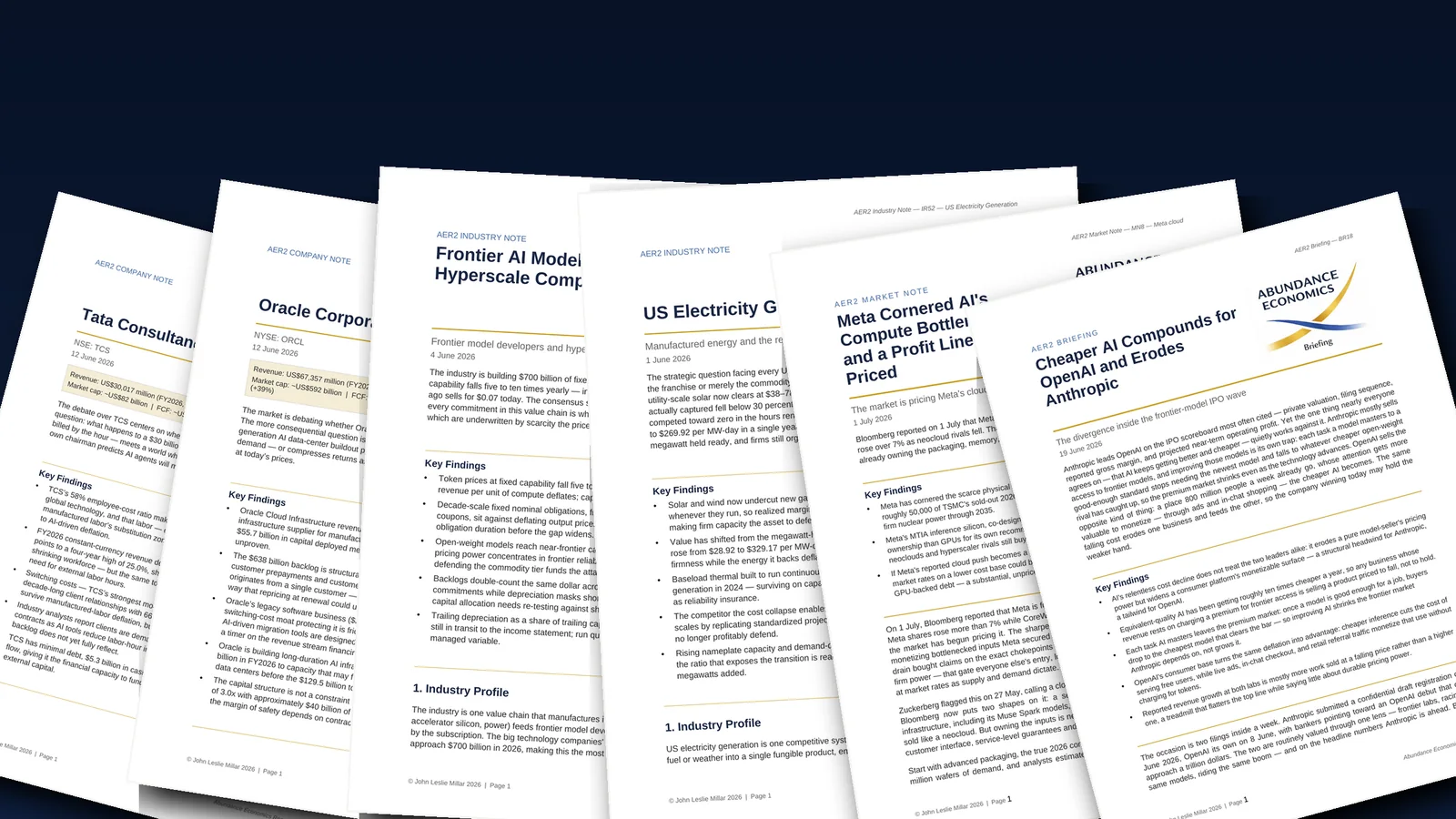
The AE model applied to 100s of real cases
Abundance Economics Research applies the framework from the book to companies, industries, sectors, markets and current events. It identifies mechanisms, second-order effects and strategic implications that conventional analysis may miss, misinterpret or recognise too late, giving readers a more revealing understanding of what is happening and a stronger basis for action.
See changing company economics earlier
Identify where a company's economics may be changing before those changes are fully visible in reported results or reflected in market expectations.
Understand where value and power are moving
Show how falling costs, weakening entry barriers and changes in value chains may shift pricing power, profit pools and competitive advantage.
Anticipate the sequence of disruption
Reveal which industries are likely to be exposed first, why the timing differs and how disruption may spread across the wider sector.
Separate structural change from market noise
Interpret company announcements, market reactions and current events by separating temporary noise from structural change.
Turn complex developments into implications
Examine complex developments in greater depth, tracing their underlying mechanisms and translating them into implications for business, investment and policy.
The research base now contains hundreds of published reports and articles, with more being added all the time, giving readers a more discriminating view of where value, risk and competitive pressure are moving—and a stronger basis for deciding what to do next.
Subscribers receive new Company Notes, Industry Notes, Sector Reports, Market Notes and Briefings as they are published.
Engage with Abundance Economics
The author is available for keynote speaking, senior leadership and board presentations, and corporate engagements.
Give your leadership team the tools to see what is changing before it appears in the numbers.
An Abundance Economics engagement helps decision-makers identify structural change, understand its implications and determine where action can create or protect value.
See structural change earlier
Identify where falling work costs, new competitors, weakening moats or changing customer economics could affect the organisation before the consequences appear in reported results.
Judge what matters
Connect technological change to its effects on costs, revenues, pricing power, assets and skills. Distinguish consequential developments from temporary noise and identify assumptions that may no longer hold.
Gain more time to respond
Separate immediate exposure from longer-term change. Identify the indicators and trigger points that clarify what requires action now, what needs preparation and what can be monitored.
Deploy AI where it creates the greatest benefit
Identify where AI can reduce costs, increase capacity, improve quality or strengthen competitive position. Prioritise applications by economic benefit, implementation cost, feasibility and strategic importance.
Engagements can take the form of an executive or board briefing, a facilitated strategy workshop, a keynote presentation or a focused examination of a specific business, investment or policy question.
Depending on scope, outputs can include an executive briefing, a prioritised decision agenda, and a set of indicators and trigger points for continued monitoring.
Discuss an engagement
Dr John Leslie Millar
Dr Millar has worked across two operating environments. In frontier technology, he co-founded one of Europe’s earliest technology accelerators in Cambridge and later worked with organisations in Silicon Valley and the Stanford ecosystem.
In established institutions, his experience spans medicine, C-suite leadership at a multi-billion-dollar company in Thailand’s SET100 Index, and advisory work with governments across Asia and Europe on economic strategy, technology and implementation.
Abundance Economics draws on that combination: examining how fast-moving technologies collide with capital constraints, regulation, institutional incentives and long decision cycles.
How to reach Abundance Economics
General enquiries, media, speaking and workshop discussions:
contact@abundance-economics.comThank you—your enquiry has been sent.
The form could not send your enquiry. Email contact@abundance-economics.com directly.